Black Seminoles
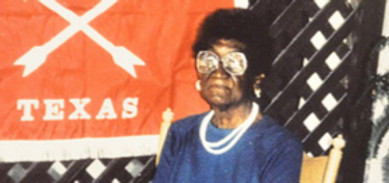
Miss Charles Emily Wilson, Black Seminole. Image available on the Internet and included in accordance with Fair Use law.
Africans on the North American Frontier, 1501-1848
Texas played a crucial role in the history of runaway slaves, hosting a far larger population of freedom seekers than the West Coast. The long and dangerous journey from the Sabine River to the Rio Grande became the southwestern route of the Underground Railroad, a pathway through which enslaved African Americans sought freedom beyond the reach of U.S. slavery. Among the most remarkable stories associated with this network are those of the Seminole Maroons—more commonly known in Texas, Oklahoma, and Mexico as the Black Seminoles.
The term Seminole Maroon refers to a community of African Americans who escaped slavery and established autonomous societies through armed resistance and strategic alliances with Seminole Indians. Between 1812 and 1849, during the height of American westward expansion, these communities challenged both slavery and U.S. territorial conquest. Their resistance occurred at a time when the United States was rapidly expanding its economy, extending slavery into new territories, and promoting ideals of white settlement and dominance.
The word maroon historically described large groups of self-emancipated Africans who fled bondage and established independent communities in remote environments such as swamps, forests, caves, and river valleys. These settlements served as permanent refuges from slavery and often became centers of military resistance. Derived from the Spanish term cimarrón, originally used to describe domesticated animals that had escaped into the wild, the word later came to refer primarily to runaway Africans and carried connotations of fierceness, independence, and refusal to submit. Among the Creek peoples, Black fugitives were initially known as estelusti, while Spanish influences introduced terms such as cimalon and cimanol.
The Seminole Maroons survived because of their extraordinary military skills and adaptability. Constantly threatened by slave catchers, rival Indigenous groups, and colonial armies, they nevertheless built thriving communities. Although frequently outnumbered and confronted by opponents with superior weaponry, they preserved their independence and developed a distinct culture rooted in both African and Indigenous traditions.
Their economy combined African agricultural knowledge with local Indigenous practices. Seminole Maroons cultivated corn, yams, and rice, drawing on farming techniques originating in the Senegambia and Sierra Leone regions of West Africa. Labor was organized cooperatively: men hunted during seasonal expeditions, while women of both African and Seminole backgrounds farmed, maintained households, and shared domestic responsibilities. This reciprocal economic structure strengthened community cohesion and resilience.
The alliance between Seminoles and Maroons was one of the most significant examples of interracial cooperation in early American history. Africans were welcomed into Seminole territory as military allies in a common struggle against European and American expansion. Intermarriage occasionally occurred, although the Seminoles generally maintained political and social distinctions between the two groups.
After 1783, a relatively lenient form of bondage emerged in which Seminole Maroons retained their homes, farms, livestock, and local autonomy while paying annual tribute to Seminole leaders in exchange for protection. Although this arrangement left them legally dependent on the Seminoles, it was fundamentally different from the chattel slavery practiced throughout the American South.
The relationship was mutually beneficial. Seminole Maroons learned Indigenous skills of hunting, fishing, herbal medicine, and environmental adaptation, while adopting aspects of Seminole dress and culture. In return, the Seminoles incorporated Maroon military strategies, including guerrilla warfare, camouflage, decentralized leadership structures, and systems of coded communication using drums and horns. These shared practices enabled both communities to resist the growing pressures of European colonialism and U.S. imperial expansion.
From the 1680s until the U.S. acquisition of Florida in 1819, many Seminole Maroons escaped from the plantation regions of South Carolina and Georgia and sought refuge in Spanish Florida, particularly around St. Augustine and northeastern Florida. Following the War of 1812, however, the United States intensified its expansion into the Southeast. Driven by the growth of cotton production and an early form of Manifest Destiny, federal authorities increasingly targeted both Seminole and Black communities. The resulting conflicts culminated in two costly Seminole Wars that reshaped the lives of Indigenous peoples and freedom-seeking African Americans throughout the region.
The Seminole Wars
The First Seminole War emerged from longstanding tensions along the Florida-Georgia frontier between Seminole communities and white settlers. These conflicts intensified as white Georgians sought to recapture African Americans living among the Seminoles, whom they claimed were escaped slaves.
At the same time, Spain's ability to support its Florida colonies weakened considerably as resources that had previously supplied Seminole allies at Fort Mose and St. Augustine were redirected to Spain's struggle against Napoleon Bonaparte's occupation of the Iberian Peninsula. Perceiving Spanish authority as vulnerable, white settlers and militia forces in East and West Florida launched rebellions beginning in 1810 with the goal of annexing Spanish territory to the United States.
What began as a border conflict evolved into a broader military struggle involving Seminoles, Black Seminoles, Spanish authorities, American settlers, and eventually the U.S. government. The intervention of Creek allies and U.S. forces under Andrew Jackson decisively shifted the balance of power against the Seminoles.
The conflict's aftermath culminated in the Adams-Onís Treaty of 1819, through which Spain ceded Florida to the United States while establishing boundaries between Spanish and American claims in the Southwest. For the Black Seminoles, however, the treaty brought little security. Some continued to resist in Florida, while others dispersed to Texas, the Caribbean, Oklahoma, and even Southern California in search of refuge from slave catchers and military persecution.
*******
The Second Seminole War had even more devastating consequences for the Seminole people. By the 1830s, the federal government increasingly disregarded treaty obligations with Native nations and embraced Indian removal as a central component of westward expansion. This policy was supported by a popular national ideology that celebrated Anglo-American settlement, portrayed westward migration as a divinely sanctioned mission, and depicted Indigenous peoples and other racial minorities as obstacles to progress.
The Indian Removal Act of 1830 further institutionalized this vision by reducing Native nations to dependent wards of the federal government and authorizing their relocation beyond the Mississippi River, ostensibly for their protection from encroaching settlers. In practice, such protections were rarely enforced during the administrations of Andrew Jackson and Martin Van Buren.
The immediate causes of the Second Seminole War were closely tied to efforts by southern slaveholders and government officials to suppress Seminole resistance and recover self-emancipated African Americans living among the Seminoles. The resulting conflict, fought primarily between 1835 and 1842, became one of the longest, most expensive, and most difficult wars fought by the United States against an Indigenous nation. Seminole leaders such as Osceola, Coacoochee (Wild Cat), and the Black Seminole leader John Horse (Juan Caballo) organized sustained resistance through guerrilla warfare and strategic alliances. The war cost the United States an estimated $40-60 million and approximately 1,500 military casualties.
Unlike many members of the Choctaw, Chickasaw, Creek, and Cherokee nations, who were compelled to relocate under removal policies, many Seminoles fiercely resisted forced migration. The war ultimately ended only after widespread destruction of Seminole communities, the capture of women and children, and negotiations led by Coacoochee.
Between 1837 and 1842, approximately 4,000 Seminoles and an estimated 500–700 Black Seminoles were forcibly removed from Florida to Indian Territory in present-day Oklahoma. Their relocation became part of the broader tragedy remembered as the Trail of Tears, a policy of forced displacement that transformed the lives of Indigenous peoples throughout the southeastern United States.
Source: Bibliography
| Black Seminoles | Seminole Wars |